

Breathing & quiet practice
Simple breathing practice for men under pressure
Breathing is the fastest lever you have. It works in a meeting room, in a car, in a queue, and it doesn't require anyone around you to know you're doing it. This page explains a few basic practices for men, how to pick one, and how to keep it going past the first week.
The hard part
Nothing here is complicated. The difficulty is consistency, not technique.
Start here
Slow exhale, explained plainly
The common thread in every practice below is a longer exhale than inhale. Slow breathing with an extended out-breath is the part most men notice first, and it's the easiest to do without counting carefully.
Ratio, not duration
Out-breath longer than in-breath
You don't need precise numbers to start. Breathe in through the nose for a comfortable count, then out for a longer one. If four in and six out feels strained, use three and five.
Adjust upward slowly
Stay inside comfort
The ratio matters more than the length. If the count starts to feel like effort, drop back a number rather than pushing through it — a practice you can repeat beats a longer one you avoid.
Where it works
No one has to notice
At a desk, on a corridor walk, in a parked car, waiting for a lift. The counting stays internal, so the practice fits a shared office without asking anyone around you to adjust.
Before, not after
Use it ahead of the pressure
A slow exhale ahead of a difficult call does more for you than a fast one afterwards. The point is a calmer starting position, not fixing a day that has already gone badly.
Practice one
The four-six reset
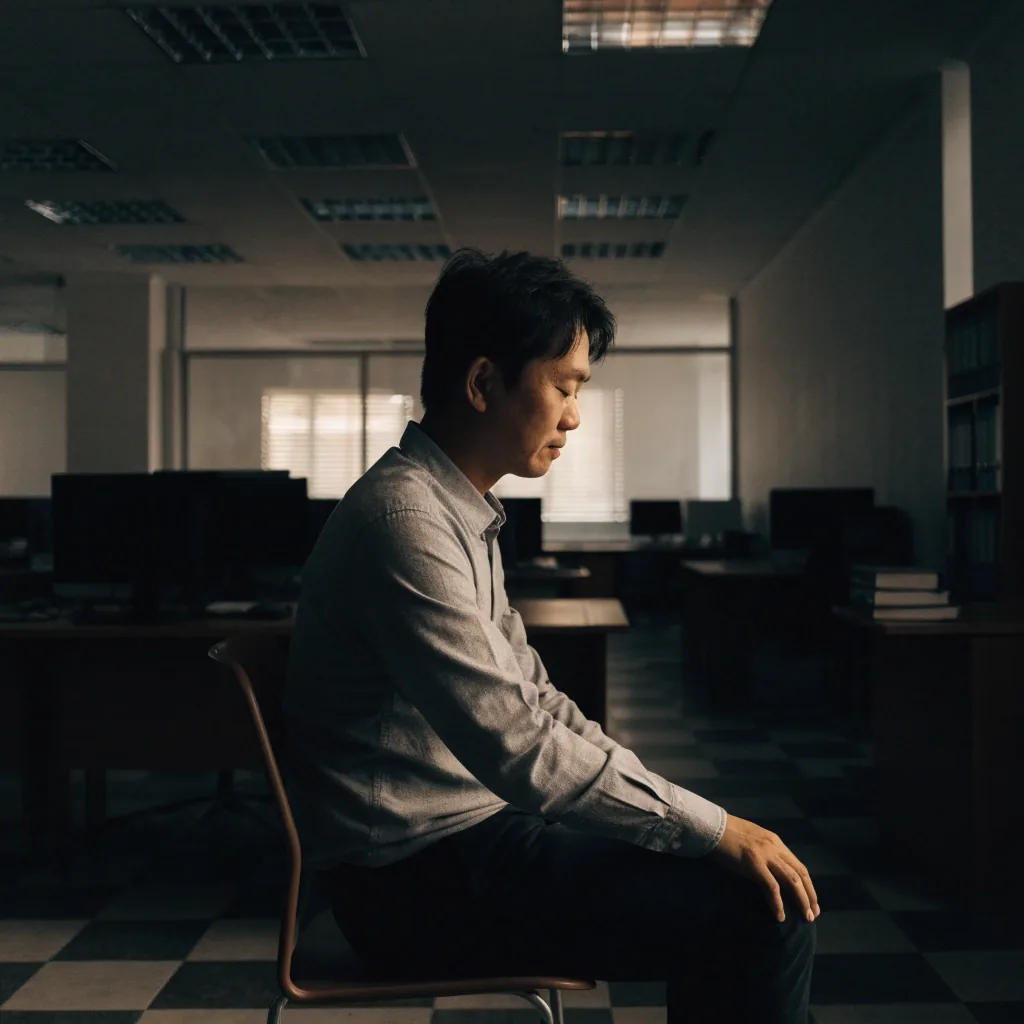
Four counts in, six counts out, repeated for two to three minutes. That's the whole method. Do it sitting, standing, or walking. Do it before a difficult call rather than after one. Doing it in advance is how it becomes useful.
Most men find this is enough on its own. It's the practice we recommend if you only ever adopt one, and it's the one to start with if you are unsure whether any of this suits you.
Stress Triggers at WorkYou already have this
Two minutes, no equipment
Four in. Six out. Repeat for two minutes — three if the room allows it. Stop while it still feels easy rather than running it until the counting becomes a chore.
Keep it consistent
The reset works best attached to something you already do: parking the car, sitting down at your desk, or the last few minutes before a meeting. The existing habit becomes the reminder.
Practice two
Box breathing
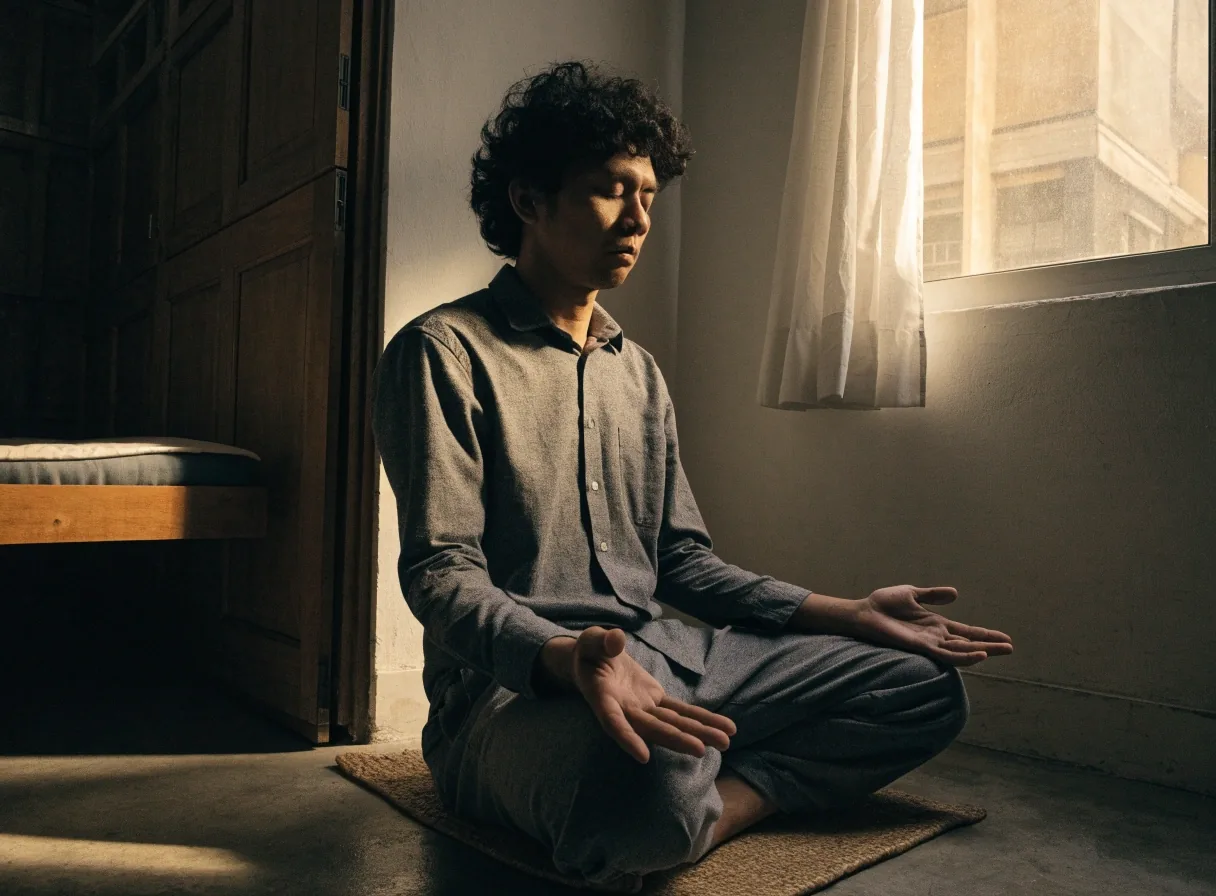
Four counts in, four hold, four out, four hold. Box breathing is more structured and slightly harder to do discreetly, which makes it a better fit for a quiet room than a shared office.
It suits men who like a defined framework and a clear finish line. The trade-off is that the holds take attention, so it's less useful when you're already scattered — the counting itself becomes one more thing to keep track of.
If that describes you, treat it as an evening practice rather than an in-the-moment one. A quiet room, one round, then carry on with your day.

Practice three
Quiet reflection
Quiet reflection isn't a breathing exercise, but it pairs with one well. Sit still for five minutes with no input: no phone, no music, no podcast. Let your thinking run without steering it.
This is the practice most men who dislike talking about stress end up preferring. There's no technique to get wrong and nothing to report to anyone. The only rule is that the five minutes stay uninterrupted.
No input
Phone down and out of reach, not face-up beside you. Music and podcasts count as input too.
No steering
Let the thinking run. When it wanders, that's not failure — noticing it is the whole exercise.
Five minutes
Uninterrupted. Set it alongside a breathing round or run it on its own before sleep.
Choosing
Which one should you pick
Pick the practice that fits where you actually get tense. If it's meetings and messages, four-six reset. If it's the end of the day and you can't switch off, box breathing or quiet reflection. If you can't decide, start with four-six and revisit after two weeks.
Don't run all three at once. Variety is a reward for consistency, not a substitute for it.
Tension hits in meetings
Four-six reset
Countable under a table, invisible to the room, and short enough to run twice in an afternoon without anyone noticing.
You can't switch off at night
Box breathing
The holds give your attention a defined job, which helps when the day's loose ends keep pulling at you before sleep.
You dislike the topic entirely
Quiet reflection
Five still minutes with no counting, no app and nothing to explain. Nothing to get wrong, which is often why it sticks.
You can't decide
Four-six reset
Start there and revisit after two weeks. Add a second practice only once the first one survives a busy week.
Timing
Fitting it into an Indonesian workday
The realistic slots are the commute, the ten minutes before your first meeting, the corridor between back-to-back calls, and the last few minutes before sleep. Prayer times already give many men a natural pause; a breathing practice can sit alongside rather than replace it.
Two minutes is enough. Three is generous. Anything longer and you'll start skipping it on busy days.
Slot 01
The commute
Waiting in Jakarta traffic is dead time either way. Run the simple four-six version only, and only when traffic lets you stay focused on the road.
Slot 02
Before the first meeting
Ten minutes at your desk with the door shut. Two minutes of the reset, then read your notes. The calm is a starting position, not an outcome.
Slot 03
Between back-to-back calls
The corridor walk counts. Four-six while you walk, ending when you reach the next room. Nobody in the office needs to know what you were doing.
Slot 04
Before sleep
Lying down, in the dark, phone already away. Box breathing or quiet reflection both fit here better than the midday reset does.
If you'd rather build the whole evening around it, the evening wind-down guide walks through the last hour of the day in order.
Read the evening wind-down guideWeek two and beyond
How to keep it going
Attach the practice to something you already do without thinking: parking the car, sitting down at your desk, boiling water for tea. The existing habit is the reminder.
If you miss a day, resume the next one without compensating. Doubling up to make up for lost time is how a small practice turns into a chore. Challenge-oriented routines built around pushing through discomfort appeal to men who want intensity, but a daily reset is a different job, and it's the one most men actually need.
Pick the same anchor for two weeks before changing anything. Once the reset runs without you deciding to do it, you have a habit you can build on — and that is the point where a second practice earns its place.
Compare meditation apps
Realistic range
Reading your own results
Expect small, unremarkable changes. A slightly slower reaction to a frustrating email. A shorter time to fall asleep. Better patience with family at the end of the day.
That's the realistic range, and it's worth having. If a practice makes you more wound up or you dread doing it, that's a signal to switch, not to push harder.
What tends to shift first
The reaction, not the feeling. You still get annoyed at the same email; the gap between reading it and answering grows by a second or two.
What stays slow
Everything else. Anything that arrives in a single session and disappears just as fast is not what you're building here.
When to switch
If the practice itself becomes a new source of pressure, swap it for a simpler one. A second practice, not a harder one.

Start small
Try the four-six reset today, and keep it to two minutes for the first week
If a reset that worked for you is worth sharing, we read every message and add the useful ones to the routines we write up.
Common questions
Before you start
Short answers to the questions that come up most often in the first week. If something here doesn't match your situation, the fastest route is to ask us directly.
Contact CalmMen IndonesiaIs it better to breathe through the nose or mouth?
Nose for the inhale if you can. Exhale through the nose or mouth, whichever is comfortable. If a blocked nose makes the counting awkward, switch to mouth breathing for the inhale and keep the longer out-breath the same.
Can I do this while walking or driving?
Walking, yes. Driving, only the simple four-six version, and only when traffic allows you to stay focused on the road. If the road needs your full attention, the practice waits — it's worth nothing if it takes your eyes or mind off what's in front of you.
How long before I notice anything?
Usually within the session itself, in the form of a slower pulse and a calmer next thought. Longer-term changes are gradual. If you're expecting a dramatic first session, you'll read the practice as broken when it's actually working quietly.
What if I keep forgetting to do it?
Attach it to something that already happens without a reminder — parking the car, sitting at your desk, boiling water for tea. If you miss a day, pick it up the next day rather than doubling up to make up for it.
Should I use an app for this?
Not necessarily. The three practices here work with a timer or nothing at all. If you want guided audio and a short mindfulness break you can cue up at your desk, our meditation app comparison sets out what the popular options include.
Questions that aren't on this page
Phone
+62 21 2555 1909Office
Jl. HR Rasuna Said Kav. X-2 No. 5, Kuningan, Jakarta Selatan, 12950
Monday to Friday, 09:00–18:00